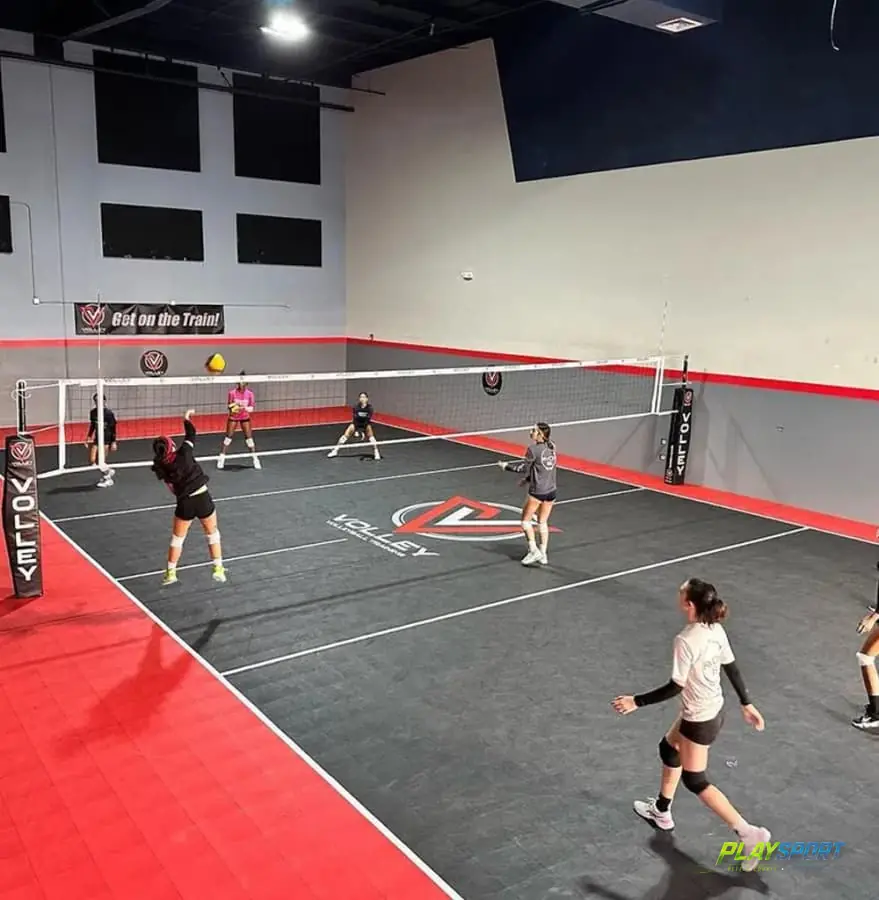
Hard-court volleyball on cushioned modular tile, with no sand to rake and no puddles to wait out. Most Atlanta families pair it with basketball and pickleball on one multi-sport game court.
Backyard volleyball in Georgia usually means one of two things: a net strung over the lawn that turns to mud by August, or a sand court that needs raking, weeding, and a drainage pit nobody wants to dig. A modular tile court gives you a real hard court with proper lines and a cushioned base, and because it sits on a slab that also carries basketball and pickleball lines, it gets used every day of the year instead of three weekends a summer.
Volleyball is a jumping sport. Our CORE tile sits on shock-absorbing pads and X COURT adds a triple-layer cushion base, so repeated landings are far kinder on knees and ankles than bare concrete or asphalt.
The tile grid drains rain straight through the joints to the slab below. No standing water on the attack line, no mud, no mildew. A summer thunderstorm rolls through and the court is playable by the time the sun is back out.
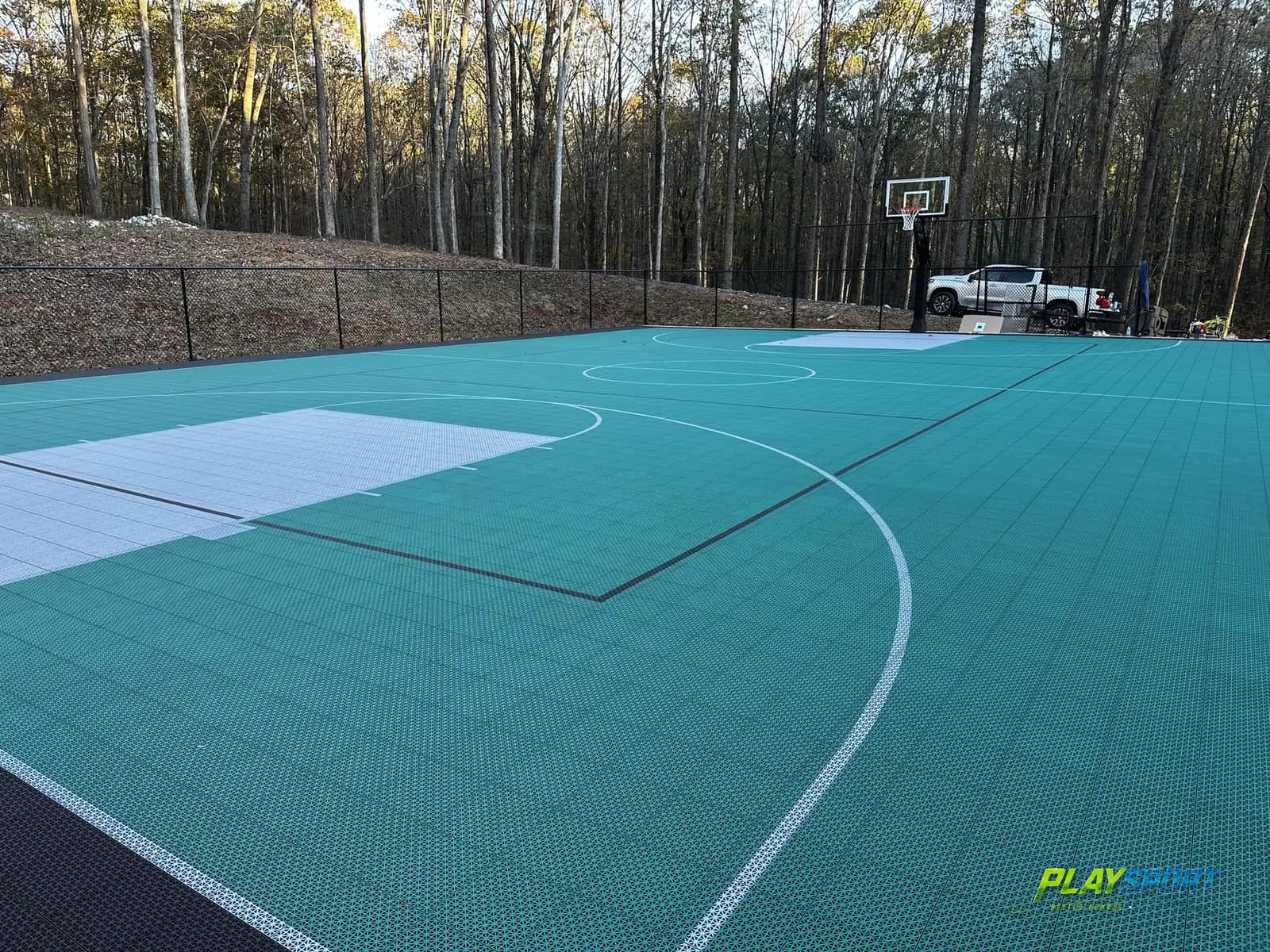
A 50 by 80 foot game court carries full volleyball lines, a full basketball court, and pickleball in different colors on the same surface. Net posts drop into sleeves set in the slab and lift out when it is time to shoot hoops.
A regulation volleyball court is 59 feet by 29 feet 6 inches, which is 18 by 9 meters. The free zone around it is where backyard builds get negotiated. Here is how we size pads around Atlanta.
Regulation indoor and hard-court dimensions. The attack line sits 10 feet from the center line on each side. Net height is 7 feet 11 5/8 inches for men and 7 feet 4 1/8 inches for women; our posts adjust for both and for kids.
About 10 feet of run-out on every side, which is what competitive players need to chase a dig. It also happens to be the footprint of a full basketball court, which is why this is the game court size we build most.
Regulation lines with about 5 feet of run-out on each side. A good fit for family play on a typical North Fulton or Gwinnett lot, and still big enough for a basketball half court on one end.
The court lines fit with almost no run-out. We only recommend this when the pad already exists, for example an old tennis court or a wide driveway apron, and the goal is casual family volleyball rather than league play.
Type your pad size into our free Court Lab designer to see how basketball, pickleball, and volleyball lines fit together on it, then pick colors and export a rendering for your HOA.
Open Court Lab →Of all the courts we have built around Atlanta, very few pads were poured for volleyball alone. The slab is the expensive part, and once you have a 50 by 80 foot slab, adding a basketball key and pickleball lines costs a fraction of the base. Here is how a typical multi-sport game court comes together.
Prefer a dedicated pickleball court instead? See our Atlanta pickleball court page. For tile details, compare CORE, TRUE, and X COURT.
Volleyball courts can be built on any of our three systems. Which one we recommend depends on who is playing and how hard.
Our multi-sport workhorse. High-impact, UV-stabilized polypropylene on shock-absorbing pads with a smart-lock joint that handles Georgia's heat swings. The right call for most backyard game courts, church courts, and HOA amenity areas where volleyball shares the pad with basketball and pickleball.
FIBA-certified and built with a triple-layer cushion base and textured traction surface. If you have a club player in the house, a school PE program, or a training facility, this is the tile that takes thousands of jump landings a season without complaint.
Every court we build sits on a concrete base. A volleyball-sized pad is bigger than most, so whether you already have concrete decides most of the budget.
An old tennis court is the perfect volleyball pad: a 60 by 120 foot footprint fits a full game court with room to spare. A worn basketball slab or a large motor court works too. If the concrete is sound, the tile goes straight over it and the cracks and faded paint disappear.
We coordinate the base with our concrete partners: grading, a reinforced 4-inch slab with net-post sleeves set during the pour, and a slight pitch so water that drains through the tile runs off. After the concrete cures, the court goes down in a day or two.
Those are honest ranges, not quotes. Read our Atlanta sports court cost guide, or send us a photo and your dimensions and we will price your actual yard.
Get My Game Court Quote →Volleyball courts show up in three kinds of projects for us: families with teenagers on club teams, schools and churches that need one surface for everything, and HOAs replacing a sand court that became a litter box.
Send us a photo and rough dimensions, or we come out. We check slope, drainage, setbacks, and whether an existing slab is sound enough to tile over.
Lay out which sports share the pad, pick colors for each set of lines, add a logo. You get a rendering and a dimensioned plan view, ready for your HOA packet.
Existing slab: we clean it and core the net-post sleeves. New pad: our concrete partner grades, forms, sets the sleeves, and pours, then the slab cures for about a week.
The court snaps together in a day or two with no adhesives and no cure time. Posts drop in, net goes up, and you are serving that evening.
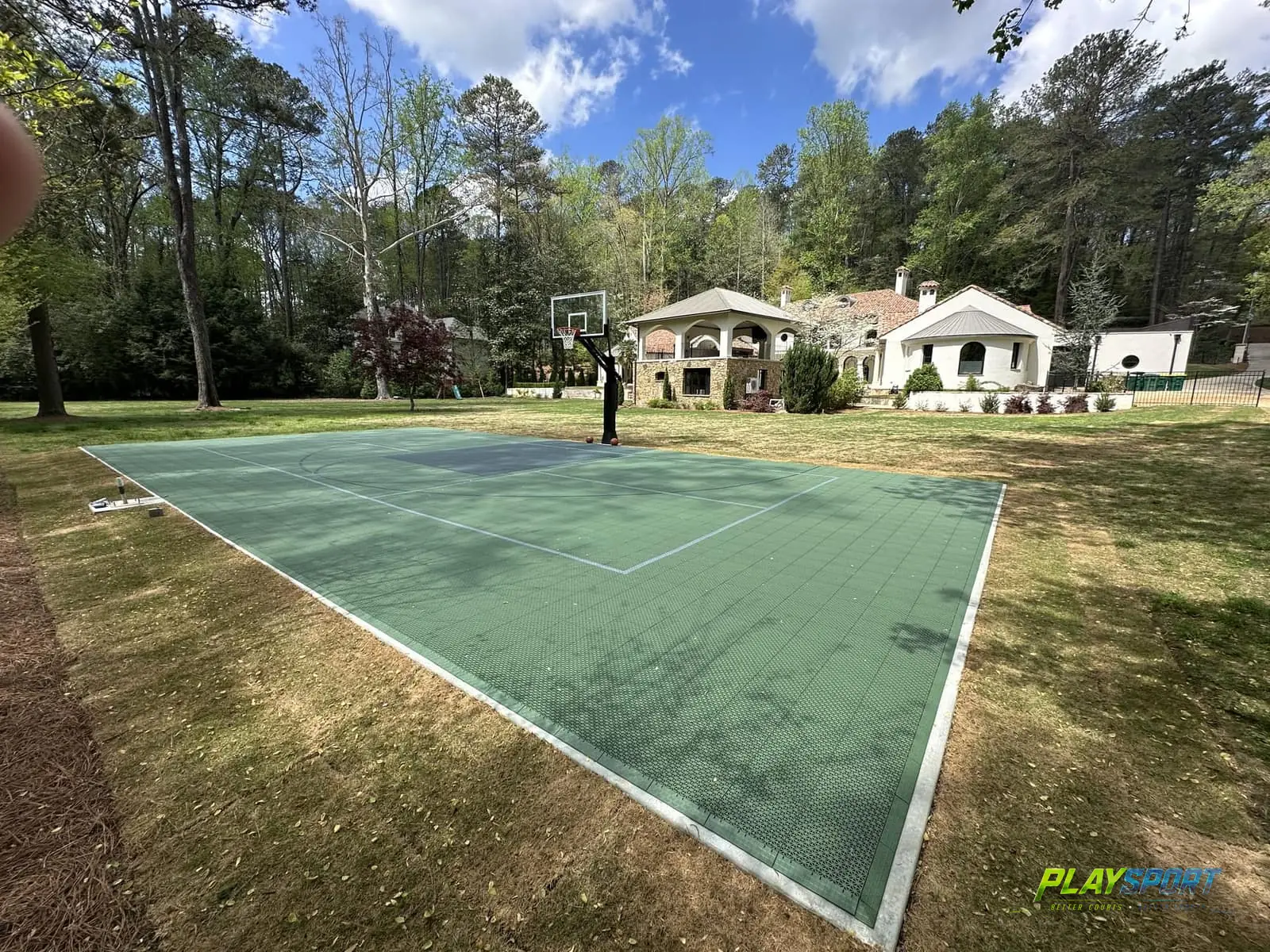
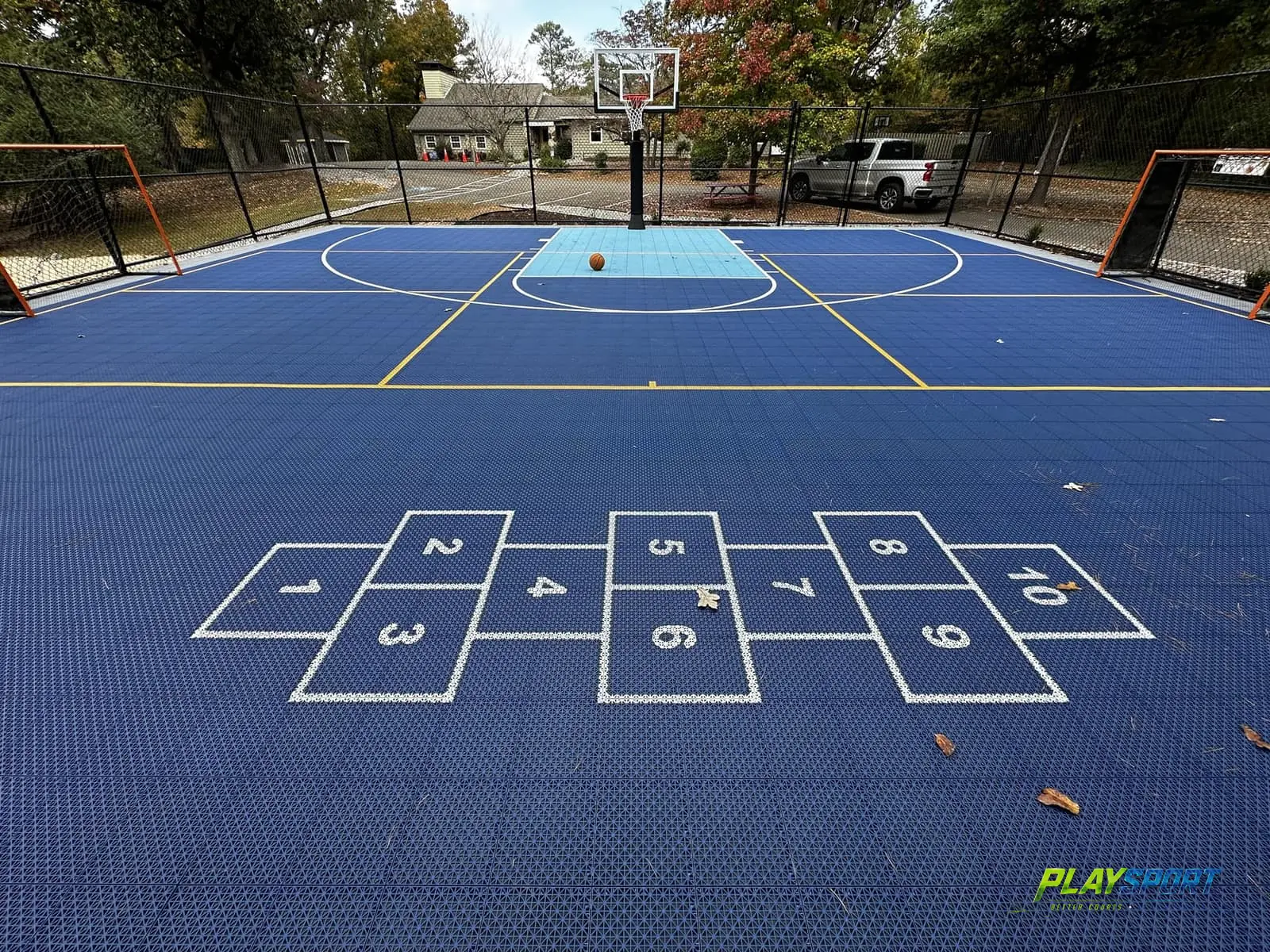
A few recent game courts. Every one is modular tile over a proper base, with each sport's lines built into the layout in its own color.
We are headquartered in Alpharetta and build volleyball and multi-sport courts across the entire metro, from in-town Atlanta to the north Georgia suburbs.
See everything we build around the city on our Atlanta sports courts page, or jump to dedicated pickleball courts.
Atlanta families have trusted our veteran-owned crew with their backyards, their schools, and their neighborhood amenity courts. Read what they said, and if we built your game court, a quick review helps the next family find us.
It depends almost entirely on the slab. Tiling over an existing tennis court or large pad typically runs mid-four to low-five figures depending on size and tile system. A new 50 by 80 foot game court with concrete is a mid-five-figure investment and up, with concrete alone running about $12 to $14 per square foot in metro Atlanta. Send us your dimensions for a real number; we respond within one business day.
The lines are 59 feet by 29 feet 6 inches. We recommend a 50 by 80 foot pad for proper run-out, 40 by 70 for a compact family court, and only go down to 30 by 60 when the pad already exists. Our free Court Lab designer shows how volleyball, basketball, and pickleball lines fit on whatever size you have.
Yes, and that is how nearly every volleyball court we build is used. A 50 by 80 foot pad carries a full basketball court and full volleyball lines at the same time, in different tile colors. Net posts sit in ground sleeves and lift out in seconds so the court is wide open for basketball.
For a backyard in Georgia, usually yes. Sand courts need a drainage pit, regular raking and weeding, fresh sand every few years, and they attract neighborhood cats. A tile court drains through the joints, needs a leaf blower for maintenance, and plays basketball and pickleball the rest of the week. If you specifically want beach volleyball, sand is the right call; for everything else, tile wins.
Yes. An old tennis court is the ideal base: the 60 by 120 foot footprint fits a full game court with room to spare, and the tile goes directly over the existing surface. Our tiles float on the concrete as a separate layer, so cracks and faded paint in the slab never show up in the playing surface. We check that the slab is structurally sound first.
We set steel sleeves in the slab during the pour, or core them into an existing slab, and the tile is cut cleanly around them. Posts drop in when you want to play and lift out when you do not, and the sleeves take a flush cap so nobody trips. The net system adjusts between men's, women's, and youth heights.
On an existing slab, a game court installs in one to two days. If we pour a new pad, add roughly a week for the concrete to cure before the tile goes down. There are no adhesives and no coatings to dry, so you can play the evening the tile is finished.
No. The tile is textured and drains through the open grid rather than letting water sit on top, which is what makes painted courts slick. After a typical Atlanta afternoon storm the court is playable within minutes.
Every PlaySport modular tile system carries a 15-year warranty and is engineered for daily play in Georgia heat, humidity, and storms. Color is UV-stabilized throughout the tile, not painted on, so there is nothing to recoat.
Talk to Michael Hansbury directly — a neighbor, not a call center. Send us your yard dimensions or a photo and we respond within 1 business day.